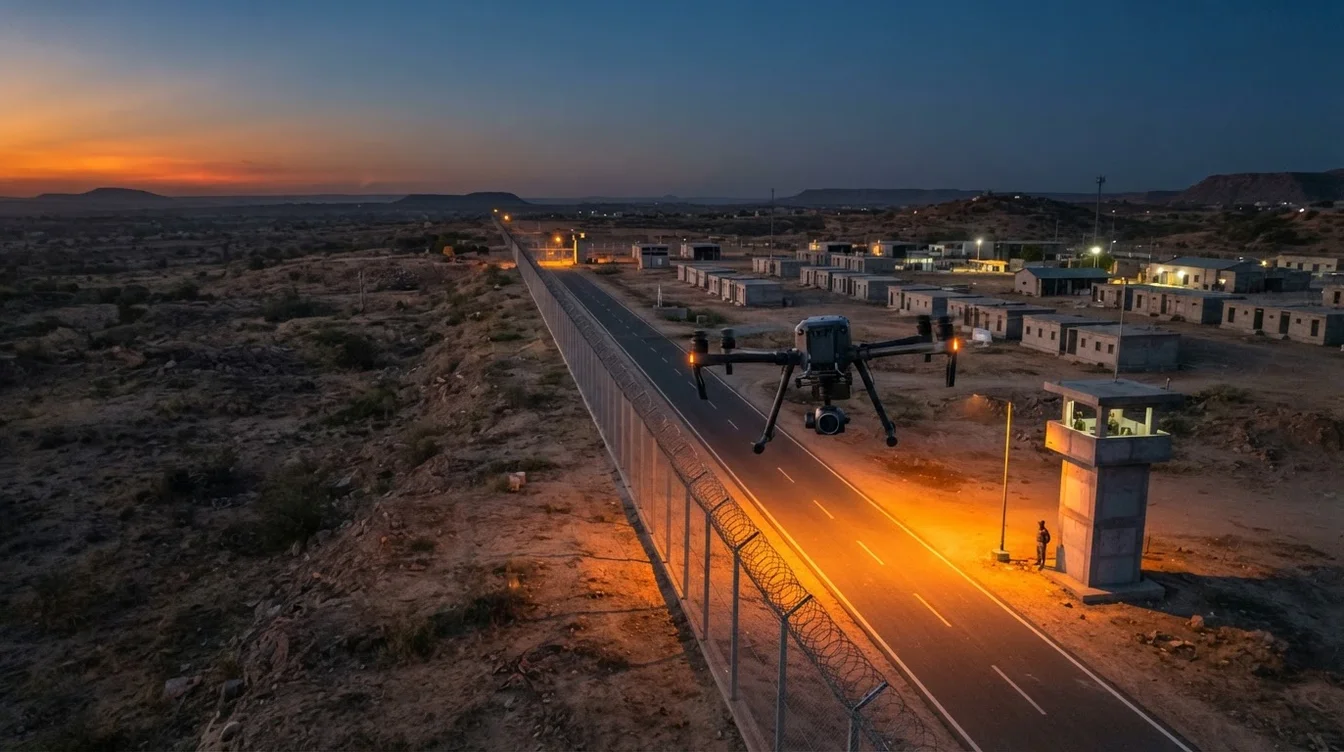
Drone-Based Perimeter Security: Fortifying India's High-Security Zones
Securing vast perimeters has always been a monumental challenge, particularly for military bases, critical national infrastructure, and other high-security zones. The sheer scale, varied terrain, and constant threat evolution demand more than traditional security measures can offer. In India, with its diverse geographical landscape ranging from mountainous borders to dense urban environments, the need for robust, adaptable, and technologically advanced security solutions is paramount. This is where drone-based perimeter security emerges as a game-changer, offering unparalleled surveillance capabilities and rapid response mechanisms.
The Evolving Threat Landscape and Traditional Security Gaps
The threats facing high-security installations are dynamic and increasingly sophisticated. From covert infiltration attempts by individuals or small groups to more organized intrusions, security forces face a constant battle to maintain an impregnable perimeter. Traditional security methods, while foundational, often present inherent limitations:
- Static Camera Systems: While providing continuous monitoring, static cameras have fixed fields of view, leading to blind spots, especially across irregular terrain or over long distances. They are also vulnerable to being circumvented or disabled.
- Human Patrols: Foot or vehicle patrols are indispensable for ground presence and rapid intervention. However, they are resource-intensive, susceptible to human fatigue, and limited by the speed and accessibility of the terrain. Covering vast perimeters efficiently and consistently with human patrols alone is a logistical nightmare.
- Fencing and Walls: Physical barriers are deterrents, but they can be breached, scaled, or tunneled under, especially with sufficient time and planning.
- Sensor Networks: Ground-based sensors can detect movement, but their deployment across vast areas can be costly, complex to maintain, and prone to false alarms from wildlife or environmental factors.
These limitations create vulnerabilities that adversaries are quick to exploit. The objective for any high-security zone is not just to detect an intrusion, but to detect it early, locate the threat precisely, and enable a swift, decisive response.
How Drones Revolutionize Perimeter Monitoring
Drones, or Unmanned Aerial Vehicles (UAVs), address many of the traditional security gaps by offering a flexible, mobile, and highly effective surveillance platform. Their ability to rapidly deploy, cover large areas, and carry advanced sensor payloads transforms perimeter monitoring from a static, reactive system into a dynamic, proactive one.
- Persistent and Adaptive Surveillance: Drones can patrol predefined routes or be dispatched on demand to specific areas of interest. A single drone can cover an area that would require multiple ground patrols or numerous static cameras, providing an elevated, unobstructed view. For instance, a medium-endurance fixed-wing UAV can continuously monitor tens of kilometers of perimeter for several hours, while multi-rotor drones offer agile, precise inspection of specific points.
- Rapid Response and Verification: In the event of an alarm from existing ground sensors or an observed anomaly, drones can be dispatched within minutes to provide real-time visual confirmation, assess the threat level, and guide ground teams to the exact location of the intrusion. This significantly reduces response times and improves the efficiency of security personnel.
- Multi-Sensor Integration for Comprehensive Detection: Modern security drones are equipped with a suite of sophisticated sensors that provide capabilities far beyond the human eye:
- Electro-Optical (EO) Cameras: High-resolution daylight cameras offer crisp, detailed imagery, crucial for visual identification of individuals, vehicles, or suspicious objects.
- Infrared (IR) / Thermal Cameras: These are vital for night operations or in conditions of poor visibility (fog, smoke). Thermal cameras detect heat signatures, making it possible to identify humans or vehicles even when camouflaged or hidden in foliage, day or night. A typical thermal payload can detect a human-sized target from up to 1-2 kilometers and vehicles from several kilometers, depending on environmental conditions and sensor quality.
- LiDAR (Light Detection and Ranging): LiDAR sensors create highly accurate 3D maps of the terrain, enabling the detection of subtle changes, such as newly dug earth, hidden paths, or alterations to the landscape that might indicate an intrusion attempt.
- Radar: Small, lightweight radar systems can be integrated into drones, offering all-weather detection capabilities, particularly useful in heavy rain or dense fog where optical sensors might be limited. They can detect movement through foliage and over long distances.
- AI and Machine Learning Integration: Advanced analytics software processes the vast amounts of data collected by drone sensors. AI algorithms can autonomously detect anomalies, classify objects (e.g., distinguishing between animals, humans, or vehicles), track suspicious movements, and even predict potential threats, significantly reducing the burden on human operators and minimizing false alarms.
Key Applications and Advantages for High-Security Zones in India
The application of drone-based perimeter security is particularly relevant and advantageous for India's strategic installations:
- Military Bases and Cantonments: From airfields to ammunition depots, vast military installations require constant, vigilant oversight. Drones can patrol the periphery, monitor restricted airspace, and provide immediate intelligence during drills or emergencies.
- Border Security: Along challenging terrains like the Himalayas or the deserts of Rajasthan, drones offer an invaluable tool for surveillance, detecting cross-border infiltration attempts where human patrols are arduous and slow.
- Critical Infrastructure: Facilities like nuclear power plants, space research centers, strategic oil and gas pipelines, and major power transmission lines are prime targets. Drones can provide continuous monitoring, detect unauthorized access, and inspect the integrity of infrastructure itself.
- Government Facilities and VIP Security: High-profile government buildings and areas hosting critical events can benefit from aerial surveillance to deter and detect threats.
The advantages extend beyond mere detection:
- Cost-Effectiveness: Over the long term, deploying a sophisticated drone system can be more cost-effective than maintaining large numbers of ground personnel or extensive, fixed sensor arrays across vast distances.
- Enhanced Situational Awareness: Security commanders gain a real-time, comprehensive aerial perspective, enabling better tactical decision-making.
- Personnel Safety: Drones can be sent into potentially dangerous or inaccessible areas, reducing the risk to human security personnel.
- Deterrence: The visible presence of patrolling drones can act as a significant deterrent to potential intruders.
- Forensic Data: All drone footage and sensor data can be recorded and archived, providing valuable evidence for post-incident analysis and investigation.
Operational Aspects and Regulatory Compliance (DGCA)
Implementing drone-based perimeter security requires careful planning and adherence to strict operational protocols and regulatory frameworks, especially in India.
- Deployment and Control: Systems typically involve a fleet of drones – some for long-endurance patrols (e.g., fixed-wing), others for agile, rapid response (e.g., multi-rotor). These are managed from a secure Ground Control Station (GCS) where operators monitor live feeds and control drone movements. Secure data links are crucial to prevent interception or jamming.
- Integration with Existing Systems: For maximum effectiveness, drone systems should integrate seamlessly with a facility's existing security infrastructure, such as CCTV networks, access control systems, and central command centers. This allows for a unified security picture and coordinated response.
- DGCA Regulations in India: Operating drones in India, especially in "No Drone Zones" which explicitly include military installations, critical infrastructure, and international borders, requires strict adherence to the Directorate General of Civil Aviation (DGCA) guidelines.
- Remote Pilot Certificate (RPC): All drone pilots must possess a valid RPC issued by a DGCA-approved drone training organization.
- Flight Permissions: Operating in restricted or "No Drone Zones" necessitates special, explicit permissions from the Ministry of Defence (MoD), the Ministry of Home Affairs (MHA), and the DGCA via the Digital Sky Platform. These permissions are granted only for specific, authorized purposes and under stringent conditions.
- Payload Restrictions: There are regulations concerning the types of payloads that can be carried, especially in sensitive areas.
- Operational Procedures: Adherence to flight plans, safety protocols, and emergency procedures is non-negotiable.
Working with a professional drone services provider like AiRotor Labs ensures that all operations are conducted in full compliance with DGCA regulations, obtaining necessary permissions, and employing certified pilots and state-of-the-art, approved equipment.
Why Choose Professional Drone Services like AiRotor Labs?
Implementing a robust drone-based security system is a complex undertaking that goes beyond simply acquiring drones. It requires specialized expertise in several areas:
- Regulatory Navigation: Understanding and securing the necessary DGCA and MoD permissions for operating in high-security zones is critical and complex. AiRotor Labs possesses the experience and knowledge to navigate these regulatory landscapes.
- Technical Expertise: Selecting the right drone platforms, sensor payloads, and software solutions tailored to specific security requirements, as well as their proper operation and maintenance, demands significant technical proficiency.
- Operational Experience: Experienced pilots and ground crew are essential for safe, efficient, and effective mission execution, especially in dynamic security environments.
- Data Analysis and Integration: Raw drone data needs to be processed, analyzed, and integrated into existing security frameworks to provide actionable intelligence. AiRotor Labs offers comprehensive data processing and reporting capabilities.
- Customized Solutions: Every high-security zone has unique challenges. A professional service provider can design and implement a bespoke drone-based perimeter security solution that perfectly matches the specific needs and threat profile of the installation.
Secure Your Perimeter with AiRotor Labs
The future of perimeter security for military bases and high-security zones in India is undeniably aerial. By leveraging advanced drone technology, these critical installations can achieve a level of surveillance, detection, and rapid response that traditional methods simply cannot match. Investing in drone-based perimeter security is an investment in enhanced safety, improved efficiency, and an unyielding defense against evolving threats.
AiRotor Labs, based in Ahmedabad, is at the forefront of providing professional, compliant, and cutting-edge drone services across India. Our expertise in aerial inspection, surveying, and security applications, combined with a deep understanding of DGCA regulations, makes us the ideal partner for fortifying your critical assets.
To discuss how AiRotor Labs can tailor a drone-based perimeter security solution for your specific requirements, please visit our booking page and connect with our experts today.
https://www.airotor.in/booking
AiRotor Labs provides drone-based inspection, aerial survey, and land survey across India.
Book a consultation →