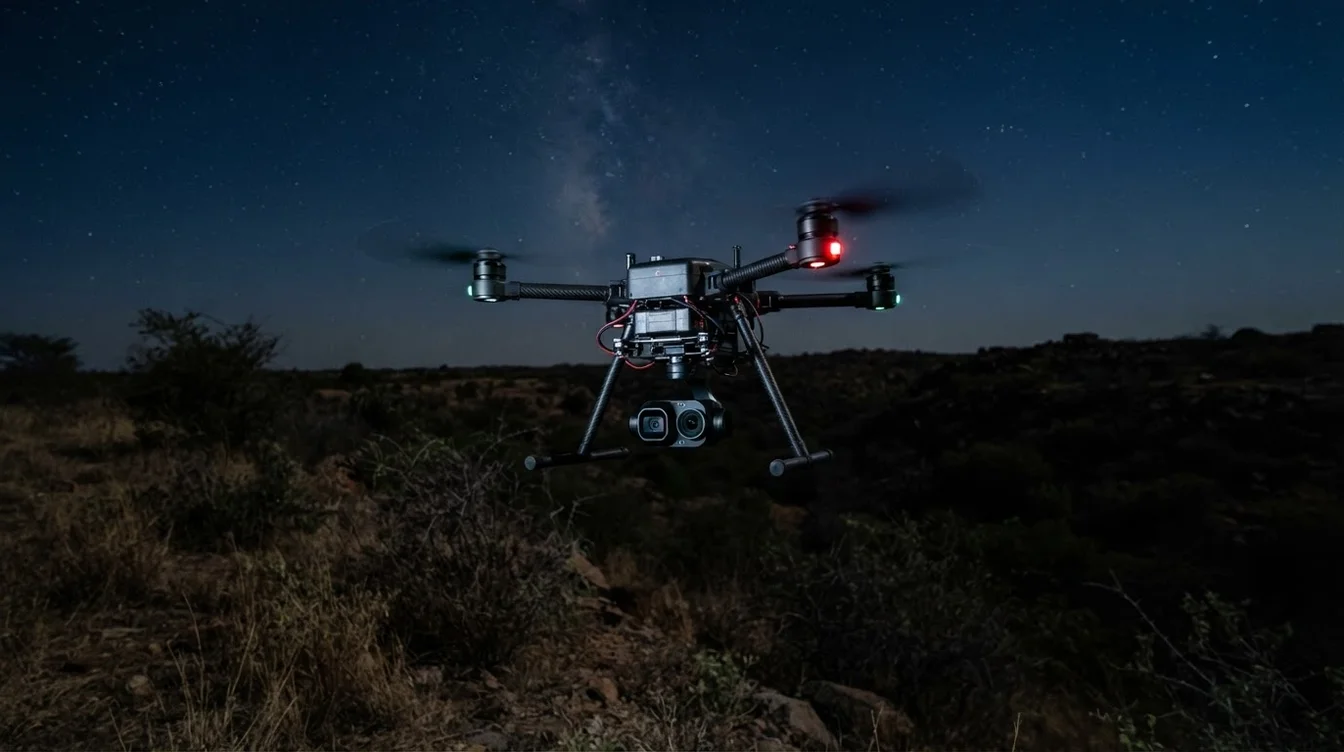
Night Vision and Thermal Drones for Defence: Payload Options and Mission Profiles
Modern defence strategies demand capabilities that transcend traditional limitations, especially when it comes to operating effectively around the clock and in challenging environments. Unmanned Aerial Vehicles (UAVs), commonly known as drones, have emerged as indispensable assets, with their utility significantly amplified by advanced night vision and thermal imaging technologies. These specialized drones provide an unparalleled advantage, offering persistent surveillance, reconnaissance, and target acquisition capabilities that are critical for national security. For forces operating in diverse and often hostile terrains, from the high altitudes of the Himalayas to the dense forests of the Northeast, night vision and thermal drones for defence are no longer just an advantage – they are a necessity.
The Strategic Imperative for 24/7 ISR Capabilities
The ability to see in complete darkness or through adverse weather conditions fundamentally alters the operational landscape. Traditional surveillance methods are often hampered by low light, fog, smoke, or dense foliage. This is where night vision and thermal imaging drones excel. Thermal cameras detect minute temperature differences, allowing them to "see" heat signatures emitted by people, vehicles, or hidden objects, regardless of ambient light. Night vision cameras, on the other hand, amplify available ambient light (like starlight or moonlight) or utilize near-infrared (NIR) illumination to render visible images in extremely low-light conditions.
For India's defence forces, facing complex challenges along its vast borders and within its internal security framework, these capabilities are paramount. Detecting infiltrators under the cover of darkness, monitoring hostile movements across varied terrains, or conducting search and rescue operations in remote, inaccessible areas at night are all missions where these drones provide a critical edge. The ability to maintain continuous Intelligence, Surveillance, and Reconnaissance (ISR) coverage, day and night, ensures proactive threat assessment and rapid response, significantly enhancing operational effectiveness and soldier safety.
Key Payload Options for Night Vision and Thermal Drones
The effectiveness of any defence drone hinges on its payload. For night and thermal operations, the following sensor types are crucial:
1. Thermal Infrared (IR) Cameras
Thermal cameras are the cornerstone of night and all-weather surveillance. They detect infrared radiation (heat) emitted by objects, creating images based on temperature differences.
- Long-Wave Infrared (LWIR): Most common for drone applications (8-14 µm wavelength). Excellent for general surveillance, detecting human and vehicle heat signatures. Resolutions typically range from 640x512 to 1280x1024 pixels, offering varying levels of detail and detection range.
- Mid-Wave Infrared (MWIR): (3-5 µm wavelength) Often used for longer-range detection and in specific atmospheric conditions where MWIR performs better. These are generally more expensive and require cryogenic cooling, but offer superior performance for specific defence applications.
- Radiometric Capabilities: Advanced thermal cameras can also measure precise temperatures, useful for identifying hot spots in engines, tracking specific targets, or assessing fire damage.
- Key Features: Digital zoom, image stabilization, object tracking, and various colour palettes to highlight temperature differences. Leading manufacturers like Teledyne FLIR offer rugged, high-performance thermal payloads designed for demanding environments.
2. Low-Light and Near-Infrared (NIR) Cameras
These cameras are designed to operate in extremely dim ambient light by intensifying any available photons.
- EMCCD (Electron-Multiplying CCD) & sCMOS (scientific CMOS): These sensor technologies offer exceptional sensitivity, capable of producing clear images even with minimal starlight or moonlight. They excel at capturing details that thermal cameras might miss, especially when objects are at ambient temperature or partially obscured.
- NIR Illumination: Some systems integrate NIR illuminators, essentially invisible flashlights that "light up" the scene for the camera without being visible to the human eye, enhancing detail and range in absolute darkness.
- Complementary Role: Often paired with thermal cameras, as low-light cameras provide excellent contextual information and identification capabilities once a thermal signature has been detected.
3. Multi-Sensor Payloads
The most advanced defence drones integrate multiple sensors onto a single, stabilized gimbal.
- Integrated Thermal + Optical + Low-Light: This configuration allows operators to switch seamlessly between different viewing modes, combining the detection capabilities of thermal with the identification strengths of high-resolution optical zoom and low-light cameras. For example, a thermal sensor might detect a heat signature, an optical zoom camera confirms it's a vehicle, and a low-light camera provides additional detail on its type or occupants in near-darkness.
- Lidar (Light Detection and Ranging): While not directly a "night vision" sensor, Lidar payloads are critical for 3D mapping and terrain analysis, providing highly accurate topographical data (down to centimetre-level accuracy) even at night. This is invaluable for mission planning, creating detailed digital elevation models (DEMs), and identifying optimal routes or hidden positions.
Mission Profiles for Night Vision and Thermal Drones in Defence
The integration of these advanced payloads unlocks a plethora of critical mission profiles for defence forces:
1. Border Surveillance & Anti-Infiltration
- 24/7 Monitoring: Persistent aerial patrols along India's vast and often challenging borders, including the Line of Control (LoC) and international boundaries. Thermal cameras can detect human movement through dense fog, foliage, or at night, providing early warning of infiltration attempts.
- Real-time Intelligence: Live video feeds are transmitted to command centres, enabling rapid assessment and deployment of ground forces. This is crucial in areas like the Punjab or Rajasthan borders, where night infiltration is a significant threat.
2. Reconnaissance & Intelligence Gathering
- Covert Observation: Drones equipped with silent propulsion and night/thermal sensors can observe enemy positions, troop movements, infrastructure, and supply lines without detection.
- Pre- and Post-Strike Assessment: Gathering intelligence before an operation to ensure target accuracy and assessing damage afterwards, all under the cover of darkness.
- Target Acquisition: Identifying and tracking high-value targets in low-light conditions, providing precise coordinates for engagement.
3. Search and Rescue (SAR) in Hostile Environments
- Locating Personnel: Rapidly locating downed airmen, lost soldiers, or civilians in inaccessible terrain, especially during night operations or in areas with thick canopy where ground visibility is limited. Thermal cameras can detect body heat through dense foliage or after dark, significantly reducing search times.
- Disaster Response: Assisting in natural disaster zones (e.g., floods, earthquakes) where visibility is low, helping locate survivors or assess damage.
4. Perimeter Security & Base Protection
- Automated Patrols: Establishing continuous, automated drone patrols around military bases, airfields, and strategic installations.
- Early Warning Systems: Integrating drone surveillance with ground sensors to provide a multi-layered defence against intrusions, detecting any unauthorized movement day or night.
5. Counter-Insurgency & Anti-Terrorism Operations
- Tracking & Over-watch: Providing crucial over-watch for ground troops during night operations, tracking suspects in urban or rural areas, and identifying potential ambushes.
- Situational Awareness: Offering commanders a comprehensive real-time view of the operational area, enhancing decision-making and troop safety in complex environments like Naxal-affected regions or Jammu & Kashmir.
Operational Considerations and the Indian Context
Deploying night vision and thermal drones for defence requires careful consideration of several factors:
- DGCA Regulations: While defence operations often fall under specific military exemptions, commercial entities supporting defence (e.g., for training, maintenance, or data analysis) must adhere to India's Directorate General of Civil Aviation (DGCA) regulations. This includes obtaining a UAOP (Unmanned Aircraft Operator Permit), operating certified drones, and adhering to flight zone restrictions (Green, Yellow, Red Zones). For defence-specific applications, procurement and operational guidelines are dictated by the Ministry of Defence.
- Endurance and Range: Defence missions demand extended flight times. While electric drones offer 30-60 minutes, hybrid (petrol-electric) drones can achieve 2-4 hours or more, crucial for persistent surveillance.
- Data Security: Given the sensitive nature of defence data, robust encryption for data links and secure on-board storage are non-negotiable.
- Operator Training: Interpreting thermal and night vision imagery requires specialized training. Operators must be proficient in distinguishing targets from environmental clutter and understanding the limitations of each sensor type.
- Integration: Seamless integration of drone data feeds into existing command and control systems is vital for real-time decision-making.
The capabilities offered by night vision and thermal drones for defence are revolutionizing how India's armed forces operate. By extending the eyes and ears of our forces into the darkest hours and most challenging conditions, these technologies provide a decisive advantage, ensuring national security and enhancing operational effectiveness across the spectrum of military operations.
At AiRotor Labs, we understand the critical needs of modern defence. While our direct services are focused on commercial and industrial applications, our expertise in advanced drone technology, sensor integration, and aerial data solutions positions us uniquely to support training, maintenance, and technological development that can indirectly benefit defence initiatives.
To explore how advanced drone technology can enhance your operational capabilities, visit us at airotor.in or book a consultation today.
Book a consultation: https://www.airotor.in/booking
AiRotor Labs provides drone-based inspection, aerial survey, and land survey across India.
Book a consultation →